
The 30-second rule

Activity-based

Workplace Principle 4: Increase Adaptability

Deciding to change or improve an office, or move to a whole new way of working, opens up a plethora of new areas to consider. One of these areas is increasing adaptability at the workplace, and it deals with the more social and behavioural elements of work.

A workplace needs to be designed in a way that makes it easier to practise good behaviours than not to. This has an impact on how the physical layout is designed and what technology is utilised. But it isn’t just physical aspects that influence how often employees change their working spaces. Employees’ degree of autonomy and need of interaction, their mobility profile, and dependence on others also bear meaning. The 30-second rule sets guidelines for how spaces can be planned to facilitate desirable behaviours.

What is it?

The 30-second rule states that the spaces most needed by employees should exist in close proximity. This could mean placing work rooms close to open-plan spaces to increase their accessibility.

Less needed spaces or those that tend to be used for planned activities like large meetings can be placed farther away.

There are two simple yet fascinating phenomena associated with the 30-second rule. 

The first is that close proximity between spaces makes moving feel less arduous, even if the physical effort in moving an additional 50 metres isn’t proportionately greater. 

The other phenomenon has to do with the knowledge that you aren’t exerting yourself in vain. A team might find it annoying to move to a project room only to find that it’s already being used by others. Or an employee might decide to take an incoming call in a phone booth only to find it occupied, making the move unnecessary.

The impact

Several of these experiences can cause people to stay put and take a phone call or a group meeting their current space, as the desired effects of the move are considered inconsistent – sometimes positive if the space is available, or negative if it is occupied.

This effect can be counteracted by visibility – either by constructing the rooms in a way that allows employees to see if spaces are available or not, or through technological tools that show availability.

Diversifying nearby spaces

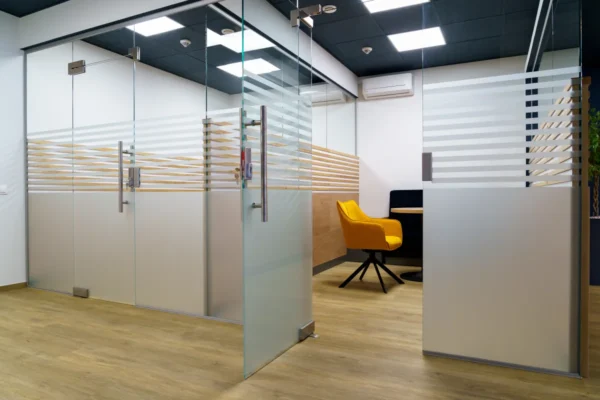
Desk spaces are what most people use as their base. By diversifying the spaces in proximity of these desks through creating small meeting rooms, work rooms, collaboration rooms, informal meeting spaces, and project spaces, you can create both closeness and visibility.

Moving to an alternate workspace should be quick and easy; it should take no longer than 30 seconds.

This is in line with research demonstrating that the meeting spaces and spaces employees use most often should be placed in close proximity to where employees most frequently work.

Further reading

This article is based on the five principles for the development of a workplace strategy that we at WeOffice use to create bespoke workplace strategies. You can read more about them here.

References are taken from the book Workplace Strategy for the Flexible Office by Aram Seddigh. For more information on the book and workplace strategy in general, click here.

References

Seddigh, A. 2022. Arbetsplatsstrategi för det flexibla kontoret : metoder, verktyg och case med fokus på hybrid och aktivitetsbaserat arbetssätt, Stockholm, Blue Publishing.

De Been I, Beijer M, Hollander D. How to cope with dilemmasin activity based work environments: results from user­centered research 2015.

Duffy F. The New Office. The New Office. 1997.

Ekstrand MAC, Hansen G. Make it work! Creating an integrated workplace concept. Journal of Corporate Real Estate. 2016;18:17–29.

Greene C, Myerson J. Space for thought: designing for knowledge workers. Facilities. 2011;29(1/2):19–30.

Stöllman Å, Eriksson T, Vingård E. Flytten till psykiatrins hus – arbetsmiljön i öppna arbetsplatser. Uppsala: Arbets­ och miljömedicin; 2015.

Read more

EU:s nya vägledning om livscykelkarbon och vad den betyder för kontorsutveckling

New EU Guidance on Whole-Life Carbon and What It Means for Office Development

The European Commission’s new staff working document on life cycle decarbonisation moves the conversation beyond operational energy and toward the building’s full climate impact. For office projects, that means reuse, refurbishment, flexibility, and long-term performance have to enter the decision process much earlier. From operational energy to whole-building climate impact The Commission’s new working document […]

Applying the Tools from the WeOffice Certified Workplace Strategist Programme in Your Daily Work

Applying the Tools from the WeOffice Certified Workplace Strategist Programme in Your Daily Work

Creating a high-performing workplace requires more than intuition. It demands a structured workplace strategy, thorough workplace analysis, and tools that translate research into action. The WeOffice Certified Workplace Strategist Programme provides exactly that – evidence-based, practical methods that professionals can apply immediately within their own organisations. This two-day programme combines leading research, workplace strategy principles, […]

See all posts

Get in touch!

Do you have any questions or would you like to get in touch? Fill in the form and we’ll get back to you as soon as we can.

Contact us

Thank you! Your form has been submitted.

Couldn’t send. Something went wrong. Please check your details and try again.

Book a meeting

    Thank you! Your form has been submitted.

    Couldn’t send. Something went wrong. Please check your details and try again.

    Book a demo

      Thank you! Your form has been submitted.

      Couldn’t send. Something went wrong. Please check your details and try again.

      Workplace Adequacy™ self-assessment

        Thank you! Your form has been submitted.

        Couldn’t send. Something went wrong. Please check your details and try again.

        Download course brochure

        Enter your details and we’ll send you the product sheet. By entering your details, you also agree to receive our newsletter.

          Thank you! Your form has been submitted.

          Couldn’t send. Something went wrong. Please check your details and try again.

          Course registration form (1)

            Thank you! Your form has been submitted.

            Couldn’t send. Something went wrong. Please check your details and try again.

            Course registration form

              Thank you! Your form has been submitted.

              Couldn’t send. Something went wrong. Please check your details and try again.