 Sv
Sv  En
En 
Share with


Blog
A workplace can look efficient and still feel unusable. The issue is often not space alone, but control: whether people can choose the right setting, shield themselves from distraction, and move between tasks without unnecessary friction. Research on control over workspace still matters because today’s offices make the cost of lost choice more visible, not less.
The issue is not comfort. It is room for action
Many office projects still focus first on efficiency, occupancy, visibility, and collaboration zones. Those are important questions, but they do not fully explain whether the work environment functions in everyday practice. As organisations move toward more shared settings, more openness, and higher expectations of flexibility, control over workspace becomes a critical issue.
People need to be able to influence where they work, how they shield themselves from distractions, when they collaborate, and which settings best support the task at hand. When that room for action is missing, friction often appears long before the problem is visible in occupancy data or traditional satisfaction scores.
For decision-makers, that means control is not a comfort detail. It is part of how the office performs as a work tool.
What the research actually found
The study by So Young Lee and Jay L. Brand examined how distractions, flexible use of workspace, and personal control over the physical work environment affected perceived performance, job satisfaction, and group cohesion.
The most useful finding was not that every distraction immediately reduced self-rated performance. The more important result was that higher perceived control over workspace, combined with better access to meeting places, was associated with higher satisfaction and stronger perceived group cohesion.
That distinction matters. Many organisations try to improve the office by chasing isolated annoyances. The larger issue is often room for action. People do not necessarily need a perfectly frictionless environment. They need a workplace where they can choose, adjust, and use the environment in ways that fit the work they are doing.
Why the problem is sharper in today’s office
The study is older, but the issue has become more visible rather than less relevant. Hybrid work, activity-based settings, and more varied daily task patterns have made the question of control sharper.
When one office has to support many different needs at the same time, the decisive question is whether people experience the environment as something they can use actively or something they simply have to adapt to. The more switching, meeting formats, and simultaneous behaviours the office is expected to support, the more costly it becomes when users lack real choice.
That is also why control over workspace needs to be connected to workplace strategy rather than reduced to a minor interior design detail.
What this means for workplace strategy and office development
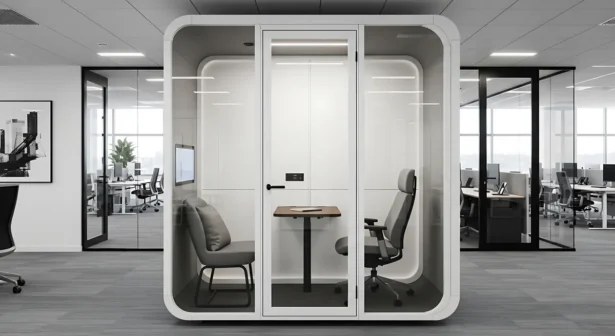
In practice, the study points toward a more mature workplace strategy. Offices work better when they combine clear structure with real choice. That can mean providing settings with different degrees of privacy, making meeting rooms and quiet areas easy to access, giving users influence over screening, lighting, or local adjustment, and avoiding an office concept built around one idealised way of working.
This is especially relevant when organisations are planning a new workplace concept or a major office change. If office design is optimised only for visibility, spontaneous interaction, or high occupancy, the result may look rational on paper while undermining satisfaction and trust in the workplace in reality.
What organisations still get wrong
Common mistakes include:
- reducing control to desks, equipment, or minor ergonomic features instead of asking whether people can reach the right setting for the task
- creating open environments with high collaboration ambitions but too few spaces for privacy and concentration
- choosing workplace concepts based on trend rather than the organisation’s actual work patterns
- designing rules and booking logic that make different settings hard to use in practice
- measuring office success mainly through occupancy or square metres per person instead of workplace support and business effect
The result is often an office that looks efficient in plan but feels restrictive in use.
What better organisations do before the next workplace change is locked
Organisations that use the office more strategically address the control question much earlier. In practice, they:
- map which work patterns require privacy, which require collaboration, and which require quick switching between settings
- make sure the office offers several realistic choices rather than symbolic variation
- design rules, booking logic, and everyday use principles so that people can actually use different settings without unnecessary friction
- follow up perceived control, satisfaction, and collaboration after move-in
- tie decisions on layout, space allocation, and function more closely to workplace strategy
This is where WeOffice should be clearly relevant. When control becomes a real everyday issue, organisations often need a fast structure for what to map first, which priorities matter most, and which changes can improve the situation without restarting the whole project.
What a better decision base looks like when control needs to be translated into office change
A better decision base should not stop at saying that people want more choice. It has to show how different levels of control affect use, collaboration, focus, and friction in practice.
In many projects, the organisation needs to compare at least four things:
- which work situations require more privacy or control than the office currently gives
- how much real choice the workplace actually offers today
- which frictions appear in booking, accessibility, and usage logic
- which changes in layout, rules, or function would create the fastest and strongest improvement
That is where WeOffice becomes directly relevant. When control over workspace has to be turned into office development, organisations often need workplace analysis, scenario comparison, and a decision base that connects behaviour, function, and workable next steps before a new layout or workplace concept is fixed.
Four questions to ask before locking the next workplace concept
- Which work situations require more privacy or control than the office gives today?
- Is the choice in the office real or mainly theoretical?
- Which rules, booking principles, or layout choices create the most daily friction?
- Which changes would create the fastest improvement in focus, satisfaction, and collaboration?
If those questions are asked early, it becomes easier to make better decisions about concept, function, and implementation.
Conclusion: better offices require choice within clear boundaries
The research shows that control over workspace is not a soft side issue. It affects how people experience the work environment, how they collaborate, and how well the office works as a support for the business.
For organisations planning a refurbishment, relocation, or new workplace concept, the conclusion is clear: a better office is not created only through more space or more modern design, but through the right degree of control over how the workplace is used. Choice, rules, and function therefore need to be designed together, not separately.
Source: Lee SY, Brand JL, Effects of control over office workspace on perceptions of the work environment and work outcomes, Journal of Environmental Psychology, 2005;25(3):323-333.
Next step
Need a clearer basis for your next workplace concept decision?
WeOffice can help build a decision base that maps friction points, compares alternatives, and prioritises which changes in concept, rules, and settings should come first. A common first step is a workplace analysis that shows where the lack of control is reducing both everyday performance and acceptance of the office.
FAQ
What does control over workspace mean in practice?
It means employees can reach the right setting for the task, switch between activities without unnecessary friction, and influence how the environment supports focus, collaboration, and privacy.
When should this be analysed in a workplace project?
It should be analysed before layout, booking rules, and workplace concepts are fixed. That is when the organisation can still improve both usability and acceptance.
Which risks should be managed before changing the workplace concept?
The main risks are symbolic choice, weak privacy support, and rules or booking logic that look efficient on paper but make the office harder to use in reality.
How can WeOffice help in the next step?
WeOffice can map friction points, compare options, and build a decision base that links behaviour, layout, rules, and function before the next workplace change moves into implementation.