 Sv
Sv  En
En 
Share with


Blog
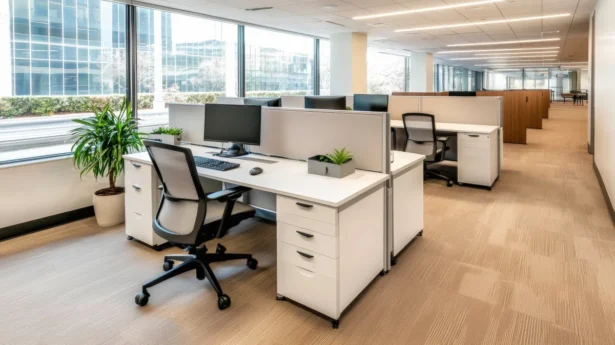
Discussions about open offices are still often driven by cost, flexibility, and symbolism. The research points to a more demanding reality. When more people share the same office environment, the issue is not only cost efficiency. Job satisfaction and wellbeing can also weaken, which turns office type into a strategic decision rather than a purely real-estate or design choice.
Why office type is often chosen on too shallow a basis
Many organisations still treat office type as a question of density and culture. That quickly turns the choice between open settings, shared rooms, and more enclosed environments into a simple symbolic decision. Either the workplace should signal openness and collaboration, or it should protect privacy and structure. What often gets lost is the practical impact on how people actually experience working there.
That is what makes this study useful. It does not only ask whether people prefer one office type over another. It also tests how the relationship between office type and job satisfaction partly runs through ease of interaction with co-workers and subjective wellbeing.
That makes the result more useful for decision-makers. The question is not only which office type is cheapest or most flexible. It is which type of office helps the organisation function better over time.
What the study actually shows about open offices, wellbeing, and satisfaction
The study found a negative relationship between the number of co-workers sharing an office environment and employees’ job satisfaction. Employees in small and medium-sized open-plan offices reported lower levels of ease of interaction, lower subjective wellbeing, and lower job satisfaction than employees in cellular or shared-room offices.
That matters because open offices are often justified through the promise of easier communication and better collaboration. The findings point in a different direction. When too many people share the same environment, interaction does not automatically become easier. It may instead feel worse, while wellbeing declines at the same time.
That does not mean every open environment is wrong. But it does mean that the assumption that open equals better collaboration is too weak as a decision rule.
Why this becomes a workplace strategy issue
Once office type affects both wellbeing and job satisfaction, it can no longer be treated as a pure real-estate logic. It needs to enter workplace strategy and the early definition of how work is meant to happen on site.
An organisation that chooses a more open office type without weighing privacy, low-distraction work, and perceived control risks ending up with a workplace that looks rational on paper but performs weakly in daily use. That becomes especially costly when the office also has to support learning, judgement, confidential conversation, leadership work, and longer concentration periods.
This is also why the issue sits close to workplace analysis. Without a clear understanding of work patterns, privacy needs, and pressure points across teams, office type easily becomes a generic norm rather than a grounded decision.
Cost efficiency is not a sufficient argument
The study explicitly warns decision-makers not to focus only on cost-effective layout, flexibility, and productivity. That is a necessary correction because many office projects still argue as if lower cost per person is enough to justify a more open solution.
The problem is that these calculations become too short if they fail to include what lower wellbeing, weaker satisfaction, or poorer day-to-day usability do to the workplace over time. A layout that looks efficient in the planning stage can become expensive if it creates more friction, weaker focus, or greater dissatisfaction than expected.
That is the same logic organisations need when moving ahead with office fit-out choices. The right decision is not always the one that looks cheapest at layout stage, but the one that performs better over time.
Common mistakes when office type is chosen on the wrong basis
- The organisation assumes more openness will automatically improve collaboration.
- It uses cost per workstation as a stronger decision factor than wellbeing and usability.
- It does not test which groups or tasks are most vulnerable to a more open environment.
- It confuses flexibility with a reduced need for privacy.
- It treats office type as a design preference rather than a business decision.
What does a better decision base look like when office type has to be chosen?
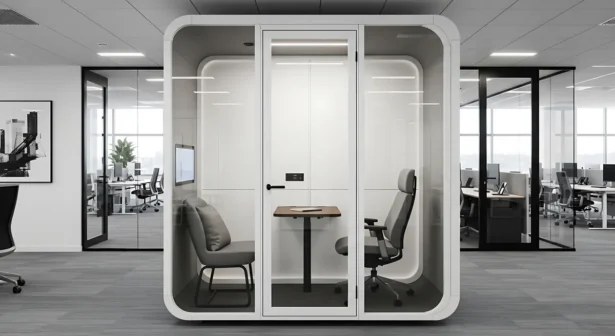
A better decision base has to compare office types through the lens of real work patterns rather than capacity and visual planning alone. Only then can the organisation judge where openness helps, where it harms, and where more enclosed settings need to be protected or strengthened.
That decision base should at least include:
- a view of which work situations need low distraction and higher privacy
- a comparison of how different office types affect interaction, wellbeing, and job satisfaction
- a trade-off between cost efficiency and actual usability
- an analysis of which teams or roles are most likely to be harmed by more openness
- a plan for reviewing the chosen office type after move-in
That is where WeOffice becomes relevant. When the organisation needs to weigh concept choices, work environment, and next practical steps against one another, it often needs scenario comparison, workplace strategy, and clear decision criteria before the workplace concept is fixed.
Four questions to ask before choosing a more open or more enclosed office type
- Which groups need more privacy than the current or planned setting provides?
- What kind of interaction are you actually trying to improve, and what does it require in practice?
- What happens to wellbeing and work quality if more people share the same environment?
- Which long-term cost is greater: slightly more space or a workplace that functions worse?
The research shows that office type influences more than how space is organised. It affects how people feel, how they experience their work, and how well the environment supports the organisation. For teams choosing a new workplace concept, that means the decision between more open and more enclosed settings cannot be made on cost logic alone. It has to become a leadership decision about how work should function.
Source: Otterbring T., Pareigis J., Wästlund E., Makrygiannis A., Lindström A., The relationship between office type and job satisfaction: Testing a multiple mediation model through ease of interaction and well-being, Scandinavian Journal of Work, Environment & Health, published 2018.
Next step
Need to weigh office type, wellbeing, and usability before the next decision?
WeOffice helps organisations compare workplace concepts through workplace strategy , workplace analysis , and clear scenario comparison. That makes it easier to choose the right balance between openness, privacy, and workplace performance before the next office concept is locked.
FAQ
Are open-plan offices always worse for job satisfaction?
Not always, but the study shows that more open environments can be associated with lower wellbeing and lower job satisfaction than cellular or shared-room offices.
Does that mean cellular offices are always best?
No. The real issue is which mix of settings best supports the organisation. But the findings do show that more openness cannot be assumed to be an automatic improvement.
Why is cost efficiency not enough as an argument?
Because an apparently cheap layout can become expensive if it weakens wellbeing, focus, and the practical quality of work.
When should office type be decided?
When the organisation has a clear enough picture of work patterns, privacy needs, and which workplace settings must function without unnecessary friction.